

Do you remember the last time your company performed a comprehensive B2B competitive analysis? And more importantly, did you perform each step effectively to find accurate, helpful direction?
If you’re unsure or not exactly proud of your answer, we’re here to help. This is your reminder that B2B competitive analysis is not only one of the most powerful business tools you can use, but also essential to understanding where you stand among your competitors by following the right B2B competitive analysis steps.
A strategic B2B competitive analysis could be one of the key areas keeping your company from reaching its sales goals. In this article, we’ve outlined everything you need to know about B2B competitive analysis and how you can conduct one effectively.
Quick Takeaways
- B2B competitive analysis allows you to identify market gaps, develop your offerings, discover new market trends, and maximize your marketing and sales tactics
- 74% of B2B companies complete competitive analysis at least once per year
- Categorizing competitors as primary, secondary, and tertiary will help you more effectively gain a full understanding of their successes and failures
- Reviewing your competitors’ content marketing strategy is key to learning how they build meaningful customer relationships
Conducting a B2B competitive analysis will help maximize product development, identify channels worth investment, and effectively support sales and marketing efforts.
What Is B2B Competitive Analysis?
A B2B competitive analysis is a strategy that calls for researching a competitor’s sales, products, and marketing efforts, all in an effort to build a stronger business strategy. It’s so important to a company’s performance that 74% of B2B marketers analyze their competitors at least once per year. More than a third are analyzing competitor behaviors monthly.
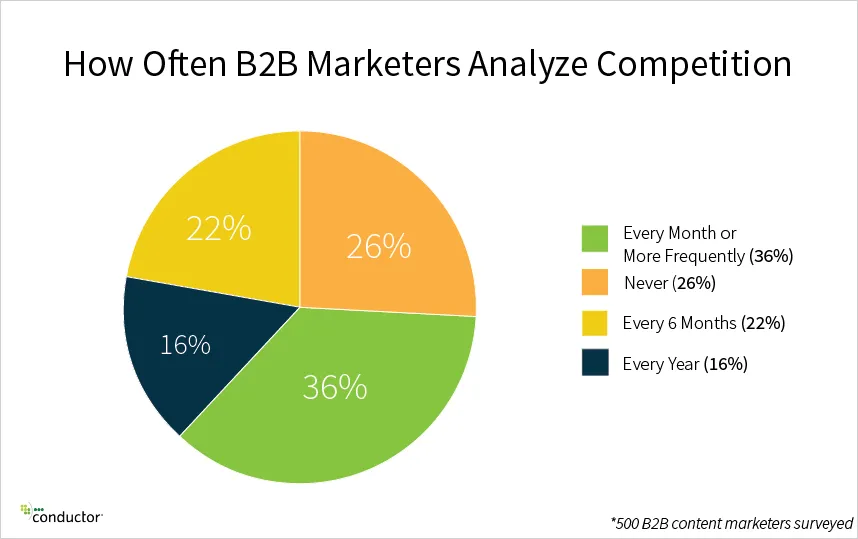
Conducting a B2B competitive analysis can help businesses learn how their competitors perform, and find opportunities to out-perform them. Not to mention, it also helps businesses stay up-to-date with industry trends and standards.
Why Is B2B Competitive Analysis Important?
In order for a business to be successful, it’s important to understand the competitive landscape. By performing regular B2B competitor analysis, you can:
- Understand what makes your own product unique to avoid commoditization, ultimately helping your positioning and future marketing efforts.
- Identify your competitors’ successes and failures, allowing you to adjust your own strategy accordingly and strengthen differentiation.
- Review competitors’ customer feedback, helping you identify whether or how well your product meets customer needs
- Use your findings as a benchmark to measure your company’s growth
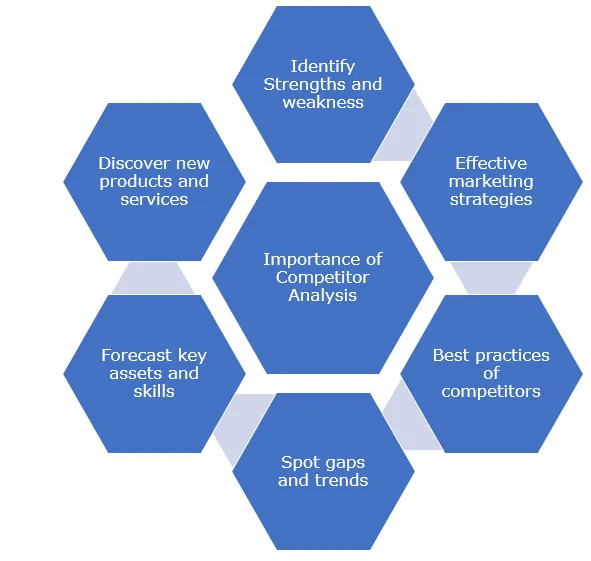
Conducting a B2B competitive analysis allows you to identify market gaps, develop your offerings, discover new market trends, and maximize your marketing and sales tactics. Clearly, these benefits can lead your company to success.
B2B Competitive Analysis Steps
Below, we have outlined how you can perform a competitive analysis to maximize your sales, marketing, and product strategies.
1. Identify Your Competition
To start your B2B competitive analysis, you need to know which competitors to analyze. While conducting both general and location-specific market research, determine which companies qualify as your top 5 competitors.
Then, you can further identify your competitors as:
- Direct (primary competition) – choose 3
- Indirect (secondary competition) – choose 2
Clarifying the level of competition you’re analyzing will help you and your team further understand your competitors’ performance.
2. Categorize Your Competition
As mentioned, it’s important to categorize your competition to gain a full understanding of their successes and failures, and how they apply to your business.
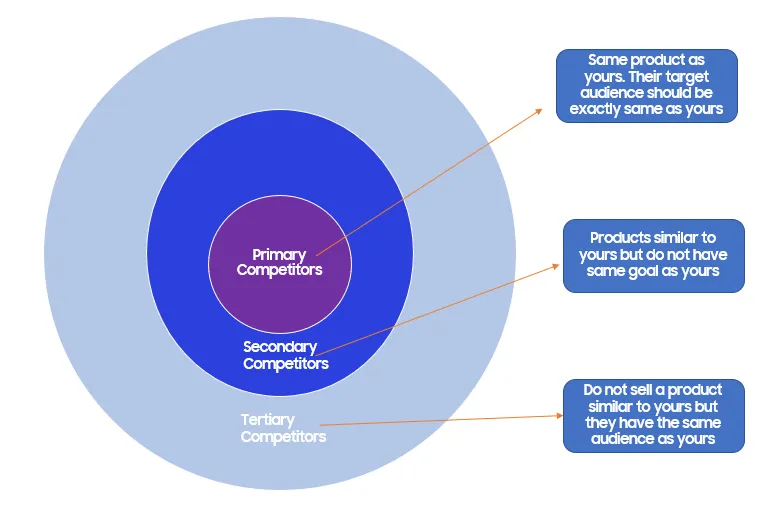
Categorize your competitors accordingly:
- Primary – businesses that sell similar products/services, share the same audience, and conduct business in the same geographic area as you
- Secondary – businesses that sell similar products/services, but do not share the same target audience
- Tertiary – businesses that do not sell similar products/services, but share the same target audience
3. Analyze Competitor Websites, Social Media, and Customer Reviews
A company’s online presence plays a major role in maximizing performance, especially for B2B businesses. Take a close look at competitors’ websites, content, social media followings, and customer reviews to gain an understanding of their online presence. For example, review their:
- Blog Page. What is their blog strategy? What are they communicating in content marketing? Do they have an FAQ section on their website?
- Products. How are they presented on their website, social media accounts, etc?
- Engagement. How many likes, shares, and comments do they receive on social media?
- Frequency. How often are they sharing blog content? How often are they posting on social media?
- Feedback. What are customers saying about competitors’ products and services? What do they like? What needs improvement?
After learning about your competitors’ online presence, you can compare it to your own. In doing so, you may learn something that will help you maximize your own strategy.
4. Research Competitors’ Sales Tactics
Next, take a look at your competitors’ sales strategies and broader competitor strategies using AI competitor analysis. For public businesses, you can gather research from their annual reports. For private businesses, you can use CRM.
We also highly recommend attending trade shows and conferences to learn about your competitors and their strategies. Learning from your community of industry professionals and thought leaders is one of the best ways to gain valuable insight.
After collecting ample information about your competitors, identify customers who opted for competitor products, and ask:
- How do they feel about your products and services?
- Why did they choose your competitors’ products and services?
- Which specific features lead them to choosing your competitors’ offerings?
Customer responses to the questions above can be the key to learning what exactly is keeping your company one step behind the competition.
5. Review Competitors’ Content Marketing Strategies
What do your competitors’ content marketing strategies look like? Are they posting videos, blog articles, infographics, or all of the above? Reviewing your competitors’ content is key to learning how they build customer relationships. Take a look at their competitive keywords, CTAs, and other opportunities for converting site visitors. Then, compare competitor strategies to your own.
6. Conduct a SWOT Analysis
Lastly, it’s time for a SWOT analysis. SWOT stands for:
- S-trength
- W-eakness
- O-pportunity
- T-hreat
This 4-way matrix simplifies and clarifies the planning and decision making processes when it comes to adjusting your company’s strategies. You can learn more about how to properly conduct a SWOT analysis by watching the video below.
Start Conducting B2B Competitive Analysis Today
Following the right B2B competitive analysis steps could be key to maximizing your company’s performance. Not only does it help you understand your competitors’ successes and failures, but also your own.
Is your company ready to enjoy the benefits of B2B competitive analysis? With our professional training programs and expert advice, it’s easy to start implementing a strategy that promises results with B2B strategy resources. Ask about how an ISBM Membership can help you get started now, or visit ISBM today to learn more!