

You have email campaigns to write, leads to qualify, reports to run, and five tabs open trying to remember where you left off. B2B marketing rarely moves in a straight line, and it never waits for you to catch up. That’s where AI automation tools come in. These tools aren’t just flashy gadgets. They’re practical, time-saving teammates that help you stay organized, consistent, and a little less fried by Friday.
Let’s be honest — you don’t need another list of apps you’ll never use. You need tools that solve real B2B problems. You want less busywork, fewer errors, and more time for actual strategy. So we rounded up some of the top AI tools built for B2B workflows. These are the ones that actually help teams work smarter, not just faster.
Quick Takeaways:
- AI tools that make day-to-day marketing easier
- Examples of how other B2B teams use them
- Options for content, email, CRM, and reporting
- Help choosing what fits your workflow
- A few moments of well-earned relief
Why AI Fits So Well Into B2B Marketing
B2B marketing involves long cycles, multiple decision-makers, and a constant juggling act between personalization and scale. You’re expected to respond instantly, follow up thoughtfully, and stay consistent across every channel. That’s a lot for any team to handle manually.
AI doesn’t take over your job—it takes the pressure off. From writing smarter emails to segmenting your audience based on behavior, these tools give you time back. And instead of focusing on tedious tasks, you get to focus on the ones that actually need human judgment.
Ready to see how it works?
Best AI Automation Tools for B2B Marketers
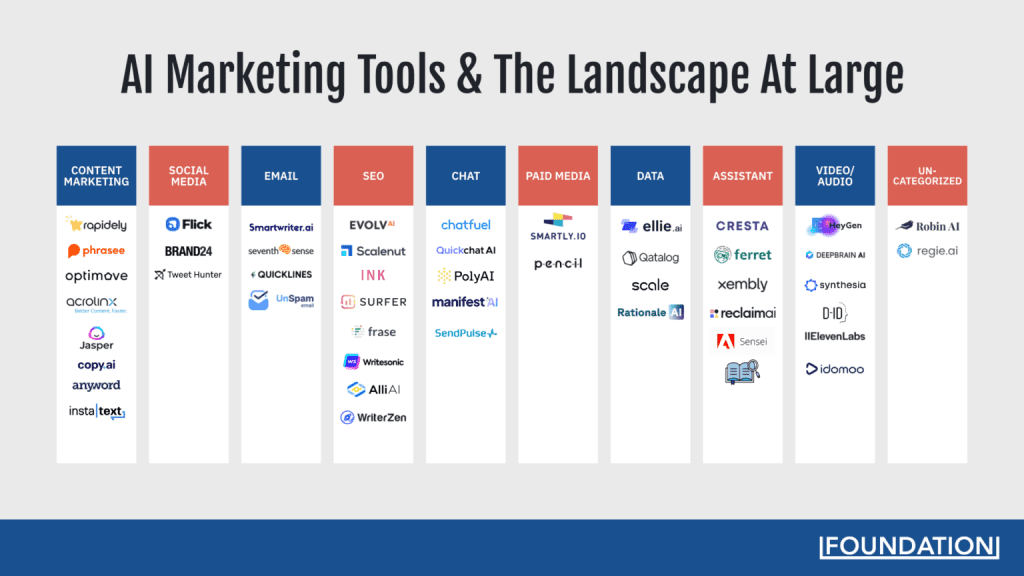
Let’s break them down by what they help you do. Each one tackles a specific part of the marketing machine, so you can pick and choose based on what’s slowing you down.
1. AI Chatbots That Actually Help
Tool: Drift
If you’re tired of chatbots that sound like bad customer service scripts, you’re not alone. Drift changed the game by making bots that actually know how to qualify leads, route conversations, and even book meetings with sales—all without sounding robotic.
You can build smart flows that feel like real conversations, not annoying loops. Instead of making people wait for a follow-up email, Drift gets prospects talking right away. For B2B, that’s a huge win. Especially when someone lands on your pricing page at 8:30 p.m. and your team’s already gone for the day.
Bonus: Drift integrates with your CRM, so it doesn’t just collect random data—it feeds your pipeline with qualified leads.
2. Content Generators That Don’t Sound Like Robots
Tool: Jasper
Jasper helps content teams move faster without sacrificing quality. Instead of writing everything from scratch, you start with prompts or templates. Want to draft a blog post, write a subject line, or refresh landing page copy? You give it the idea, and Jasper runs with it.
B2B teams use it to write product descriptions, ad copy, long-form blogs, and even case studies. It’s like having a junior writer that never takes a lunch break. You still have to edit it—AI won’t replace your voice—but it beats staring at a blinking cursor for two hours.
It’s not about cheating the process. It’s about cutting down the time it takes to go from idea to first draft.
3. Smarter Email Sequences That Adapt Over Time
Tool: Seventh Sense
Seventh Sense uses AI to figure out when people are most likely to open emails. It personalizes send times for each contact in your list based on their behavior, so you stop blasting out emails at 9 a.m. and hoping for the best.
What makes it great for B2B? You’re often emailing the same people over a long period of time. Timing matters. Seventh Sense learns from how each recipient interacts with your emails and adjusts accordingly.
It’s not just about deliverability. It’s about getting your message seen by the right people when they’re actually paying attention.
4. Predictive Lead Scoring That Isn’t a Guessing Game
Tool: MadKudu
Tired of assigning lead scores based on hunches? MadKudu uses AI to predict which leads are most likely to convert—based on behavior, firmographics, and past conversion patterns. It does the math so you don’t have to.
You’ll get a real-time score that actually means something, not just a number based on arbitrary rules. Marketing and sales teams can agree on what makes a lead “hot” because the data backs it up. That means no more internal debates about who’s ready to talk and who needs more nurturing.
For B2B companies juggling thousands of contacts and touchpoints, that kind of clarity is pure gold.
5. Analytics That Do More Than Show Charts
Tool: Pathmatics
If you’ve ever looked at a performance dashboard and thought, “Cool, but what do I do with this?”—Pathmatics gets it.
It goes beyond surface-level metrics and gives you clear competitive insights. Who’s spending what, where your competitors are advertising, what messaging they’re using—Pathmatics breaks it all down. You can even track historical trends to see what campaigns worked and which ones fizzled.
For B2B teams running paid ads or trying to position themselves differently, this saves hours of research. Instead of guessing what others in your space are doing, you get a front-row seat.
Real B2B Use Cases
Let’s make this practical. Here’s how actual B2B marketers are putting these tools to work:
- SaaS companies use Drift to pre-qualify leads and route demos to the right sales reps in minutes. No more waiting two days for someone to follow up.
- Industrial suppliers rely on Jasper to rewrite outdated product descriptions and create technical blog content that doesn’t bore readers to tears.
- B2B e-commerce teams run email campaigns through Seventh Sense to avoid peak-hour inbox noise—and see open rates jump.
- Marketing agencies use MadKudu to prioritize outreach for large prospect lists, focusing only on leads most likely to convert.
- Cybersecurity firms use Pathmatics to study competitor ad trends and adjust their messaging before trade show season hits.
How to Pick the Right Tools Without Losing Your Mind
You don’t need all five. In fact, trying to adopt too many at once will just slow you down. Focus on where your bottlenecks are right now.
Are you drowning in content requests? Jasper’s a great choice. Struggling to qualify leads? Drift or MadKudu might be your move. Want smarter emails? Give Seventh Sense a test run.
Start with one tool. Use it until it saves you time. Then move to the next.
And if your boss still isn’t sold on AI? Ask them if they’d rather pay you to write another 40 follow-up emails by hand or let a tool take care of that while you focus on the big-picture stuff.
There’s an AI Tool for Everyone
You don’t need to be a tech expert or a data scientist to make AI work for you. You just need the right tools that solve the right problems—tools that give you more time to think, plan, and execute your actual strategy.
No tool’s going to do your job for you. But they’ll take care of the parts that never needed your brain in the first place.
Start small. Try one. See how it fits. You’re already doing the hard work. Now it’s just about making it a little less…manual.
ISBM can help you stay ahead of the curve by connecting you with practical, research-driven insights into how B2B marketing is evolving. Through expert resources and peer collaboration, we provide the knowledge base and support needed to make informed decisions—especially in fast-changing areas like business market segments. Become a member today!