

While technology has undoubtedly transformed how B2B businesses operate, the significance of personal connections remains paramount. Dr. Lisa Scheer, a renowned expert in B2B marketing, sheds light on this topic in her recent presentation at the ISBM Members’ Meeting in June. Her research on boundary spanner advocacy underscores the enduring value of personal relationships in driving sales strategy and fostering inter-organizational relationships.
Quick Takeaways
- Advocacy in B2B marketing involves individuals supporting their partners’ or customers’ interests, categorized into customer advocacy and salesperson advocacy.
- Customer advocates actively promote and defend a supplier within their organization, influencing purchasing decisions and boosting loyalty and sales.
- Salespeople representing their firm’s interests to their customers can strengthen relationships and enhance sales outcomes.
- Boundary spanners bridge the gap between organizations and external partners or customers, playing a key role in maintaining strong inter-organizational relationships.
Understanding Advocacy in B2B Marketing
Advocacy in B2B marketing refers to the actions and efforts of individuals within an organization who represent and support the interests of their partners or customers. This advocacy can be broadly categorized into customer advocacy and salesperson advocacy.
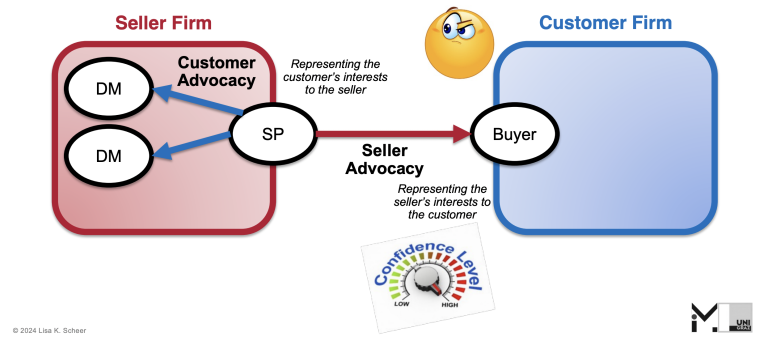
- Customer Advocacy: This involves customers actively promoting and defending a supplier within their organization. Customer advocates can influence purchasing decisions, often leading to increased loyalty and higher sales for the supplier.
- Salesperson Advocacy: This involves salespeople representing their firm’s interests to their customers. Effective salesperson advocacy can enhance the customer’s perception of the firm, leading to stronger relationships and better sales outcomes.
Boundary Spanner Advocacy
Dr. Scheer’s research introduces the concept of boundary spanner advocacy, which highlights the role of individuals who bridge the gap between their organization and external partners or customers.
These boundary spanners play a crucial role in building and maintaining strong inter-organizational relationships. By acting as liaisons, they help ensure that both parties’ interests are represented and that communication remains clear and effective.
Key Findings from Dr. Lisa Scheer's Research
Loyalty in B2B Relationships
One of the key areas Dr. Scheer explored is loyalty in B2B relationships. Her findings differentiate between “Loyalty to the Firm” and “Salesperson-Owned Loyalty.”
- Loyalty to the Firm: This refers to customers’ allegiance to the organization as a whole. Indicators of this loyalty include repeat purchases, a high share of wallet, and a good Net Promoter Score.
- Salesperson-Owned Loyalty: This pertains to the customer’s loyalty to a specific salesperson. Dr. Scheer’s research indicates that salesperson-owned loyalty significantly impacts sales outcomes. Customers loyal to their salesperson are more willing to pay a premium, leading to higher sales growth and cross-buying.
Impact on Sales Strategy
Dr. Scheer’s findings highlight that salesperson-owned loyalty can drive greater customer willingness to pay a premium. This has several implications for sales strategy:
- Greater Willingness to Pay a Premium: Customers loyal to their salesperson are often willing to pay more for the products or services offered.
- Higher Selling Effectiveness: Salespeople with strong customer relationships report higher-than-average sales growth and cross-buying.
- Objective Sales Growth: Strong interpersonal relationships contribute to measurable increases in sales performance.
The Complementary Role of Technology
In her presentation, Dr. Scheer addressed the misconception that technology diminishes the importance of interpersonal relationships. While technology, such as websites, databases, and AI, plays a critical role in modern business operations, it does not replace the need for personal connections. Instead, technology and personal relationships are complementary.
Routine repurchasing can be efficiently managed online, allowing salespeople to focus on relationship-building and understanding customer needs. This blend of technology and personal interaction enhances overall business performance.
The Role of Advocacy in Inter-Organizational Relationships
Customer Advocacy
Customer advocacy involves customers representing and defending a supplier within their organization. This type of advocacy is particularly impactful in purchasing decisions and loyalty. Dr. Scheer’s research provides the following insights:
- Influence on Purchasing Decisions: When a buyer advocates for a specific supplier, it positively influences their colleagues’ purchasing decisions, often leading to increased loyalty to that supplier.
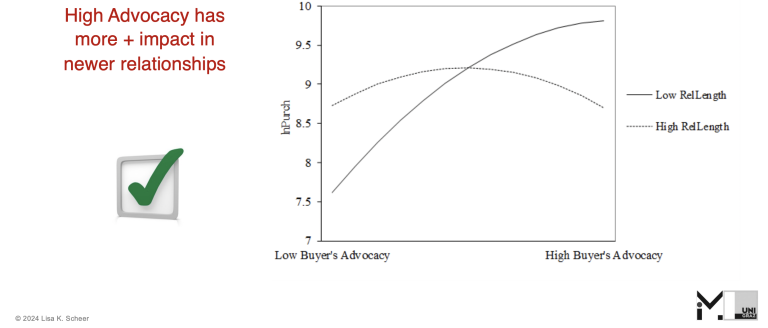
- Impact on Supplier Loyalty: Moderate buyer advocacy can more than double purchasing from the advocated supplier compared to low advocacy levels. However, overly fervent advocacy can undermine the buyer’s credibility and reduce purchasing.
- High Advocacy in Newer Relationships: Dr. Scheer’s findings indicate that high advocacy has a more positive impact in newer relationships, significantly enhancing purchasing decisions and loyalty.
Seller Advocacy
Seller advocacy involves salespeople representing their firm’s interests to the customer. Dr. Scheer’s research highlights several benefits of effective seller advocacy:
- Enhanced Customer Perception: Effective seller advocacy improves the customer’s perception of the firm, leading to greater loyalty.
- Increased Sales and Profitability: When salespeople engage in both customer and seller advocacy, customers request fewer discounts, and sellers are more likely to grant requested discounts, resulting in greater overall profit.
Balancing Customer and Seller Advocacy
Dr. Scheer’s findings suggest that balancing customer and seller advocacy is crucial for maximizing sales performance. When salespeople effectively advocate for both their firm and their customers, it leads to better outcomes for both parties:
- Fewer Discount Requests: Customers make fewer discount requests when they perceive strong advocacy from salespeople.
- Higher Profitability: Sellers are more likely to grant discounts, leading to increased profitability when both types of advocacy are present.
Practical Implications for B2B Marketers
Integrating advocacy into sales strategies is crucial for B2B marketers aiming to enhance customer loyalty and drive sales growth. Here are some actionable insights based on Dr. Scheer’s research:
Train Salespeople as Advocates
Salespeople should be trained not only to sell but also to advocate for their firm and their customers. This dual advocacy role helps build stronger relationships and fosters greater loyalty.
Leverage Technology and Personal Interaction
Utilize technology for routine transactions and leverage personal interactions for relationship-building and understanding customer needs. This complementary approach maximizes efficiency and effectiveness.
Design Effective Communication Channels
Ensure that online channels provide easy access to salespeople. This design facilitates seamless transitions between online transactions and personal interactions, enhancing the customer experience.
Encourage Repurchasing through Online Channels
Promote online repurchasing to streamline transactions, allowing salespeople to dedicate more time to value-added activities such as product introductions and relationship-building.
Achieve Sustained Growth Through Advocacy Today with ISBM
Dr. Lisa Scheer’s research underscores the enduring importance of interpersonal relationships in B2B marketing. Despite the rise of technology, personal connections remain crucial for driving sales strategy and fostering loyalty.
By understanding and implementing effective advocacy practices, B2B marketers can enhance their sales performance and build stronger inter-organizational relationships. Balancing technology with personal interaction and prioritizing advocacy will ensure businesses navigate modern markets successfully and achieve sustained growth. For more insights, the full presentation is available now on ISBM.com/library.
ISBM is a nonprofit, global network of business researchers and practitioners. Ask about how an ISBM Membership can help you now or visit ISBM today to learn more!