

Artificial intelligence is officially part of our future, regardless of pushback. In the last two years, a new category of technology – AI agents – has emerged as a practical partner for enterprise operations. These systems can analyze information, make recommendations, execute workflows, and increasingly interact with staff as if they were colleagues.
For business leaders, the problem is not whether AI agents belong in the workplace. The real question is how to integrate them responsibly, so they provide real value without introducing more risks.
Below are five strategies for turning AI agents into trusted contributors to your organization.
Quick Takeaways
- Set rules early — Clear policies and training reduce risk and accelerate AI adoption.
- Keep humans in the loop — Treat AI as a partner that needs oversight, not as an autonomous operator.
- Invest in talent — Use AI to free employees for higher-value work, but continue building skills and pipelines.
- Track performance — Hold AI agents accountable with measurable outcomes like accuracy, efficiency, and adoption.
- Start small — Introduce AI as a digital intern with structured tasks before scaling responsibilities.
1. Establish Clear Usage Policies
Every successful AI initiative starts with governance. Companies that rush into deploying agents without clear boundaries face problems ranging from inconsistent results to compliance failures. The first step is to create guidelines that define how agents can be used, by whom, and under what circumstances.
Policies should address:
- Scope of tasks: Identify where AI agents can provide immediate value, such as document drafting, meeting summarization, or workflow automation, while excluding high-risk activities like financial approvals or legal judgments.
- Data governance: Define what information AI agents can access, how sensitive data is protected, and what logging and audit measures are in place.
- Compliance: Ensure AI use aligns with relevant regulations, including GDPR, HIPAA, or industry-specific standards.
- Accountability: Make clear that AI is an augmentation tool, not an independent decision-maker. Humans remain responsible for outcomes.
Training is a crucial counterpart to policy. Employees need to know not only what the rules are, but why they exist and how to apply them in practice. At many firms, this takes the form of workshops, e-learning modules, or team-based pilots that allow staff to experiment under supervision.
Establishing this foundation reduces risk and accelerates adoption. Employees are far more likely to use the tools productively when they know what is expected and feel confident about the boundaries.
2. Treat AI Agents as Business Partners, Not Black Boxes
Despite their sophistication, AI agents are not autonomous employees. They function best when paired with human oversight. Yet too many companies fall into one of two traps: treating AI as an infallible oracle or dismissing it as a mere gadget. Both approaches undermine adoption.
The most effective organizations cultivate a “collaborative partnership” model. Employees are encouraged to interact with agents as they would with colleagues—asking questions, reviewing outputs, and providing feedback. This not only improves outcomes but also builds user trust.
Practical steps to foster this partnership include:
- Transparent design: Choose platforms that show how results were generated. Transparency builds confidence.
- Feedback loops: Allow employees to correct outputs and feed those corrections back into the system to improve accuracy over time.
- Defined roles: Position AI agents as assistants, copilots, or specialists in narrow domains, rather than as autonomous operators.
The key is dialog. Employees should feel comfortable challenging or refining AI outputs just as they would a colleague’s work. This prevents blind trust while reinforcing that AI is a tool designed to augment human expertise.
Governance and security also play a role here. Access controls, permissions, and integration checks ensure that AI systems don’t see data they shouldn’t. This structured approach builds the trust necessary for widespread adoption.
3. Build Human Talent Alongside AI Adoption
One of the most persistent misconceptions about AI integration is that it reduces the need for human development. In practice, the opposite is true. AI agents handle repetitive, structured work. This frees employees to focus on higher-value tasks—but only if organizations invest in their growth.
Without deliberate talent development, AI adoption risks creating a gap: senior leaders making strategic decisions and AI handling repetitive tasks, with too little room for employees to develop skills in between. Companies must use AI adoption as a chance to reimagine their talent pipelines.
Practical steps include:
- Redefine entry-level roles: AI may take over baseline tasks like data cleanup or research summaries, but entry-level employees still need pathways to learn. Create roles that combine AI oversight with exposure to more complex work.
- Upskill mid-level talent: Provide training in prompt engineering, workflow design, and AI oversight. These skills position employees to manage agents effectively.
- Rotate assignments: Use AI to reduce repetitive workload while ensuring employees rotate into projects that stretch their abilities.
The apprenticeship model remains valid. Junior employees still need to learn fundamentals, but now they can learn faster by reviewing, refining, and improving the work produced by AI agents. Done well, this creates stronger pipelines of talent and keeps human expertise at the center of the enterprise.
4. Measure Performance Like Any Other Employee
AI agents should not be treated as experimental side projects. To deliver value, they must be evaluated with the same rigor applied to any employee or team initiative.
Leaders should establish performance metrics from the start. These may include:
- Accuracy rates: Are outputs factually correct and aligned with business standards?
- Productivity gains: Has task completion time decreased? Have employees been freed to focus on higher-level work?
- Cost efficiency: Are agents reducing outsourcing costs, overtime, or redundant processes?
- Adoption metrics: How many employees actively use the agents, and do they report improved outcomes?
Regular audits are critical. Just as managers review employee performance, organizations should review AI performance to ensure ongoing alignment with goals. If agents fail to deliver, they should be retrained, reassigned, or phased out.
This approach also strengthens accountability. AI should not be a novelty—it should be a measurable contributor to business performance. Companies that establish clear benchmarks are far more likely to see meaningful ROI.
5. Start With the “Intern” Model
For many organizations, the best way to integrate AI is to treat it like a digital intern. Interns are expected to add value, but within clearly defined boundaries. They are given structured tasks, receive supervision, and are evaluated on outcomes. The same framework applies to AI agents.
Start with tasks such as:
- Summarizing documents or meetings
- Drafting basic communications
- Extracting insights from structured datasets
- Automating routine reporting
These activities are low risk and provide immediate time savings. As the organization gains confidence, responsibilities can expand into more complex workflows such as sales forecasting, market analysis, or workflow orchestration.
The intern model also has cultural benefits. It sets realistic expectations—AI is here to help, not to replace. Employees understand that the agent is part of the team but requires oversight. This framing reduces resistance and accelerates adoption.
The Bigger Picture: Why Integration Matters
AI agents are not a passing trend. They represent a structural change in how businesses operate. The companies that succeed will be those that move beyond experimentation and integrate agents into daily operations with discipline.
The benefits are significant:
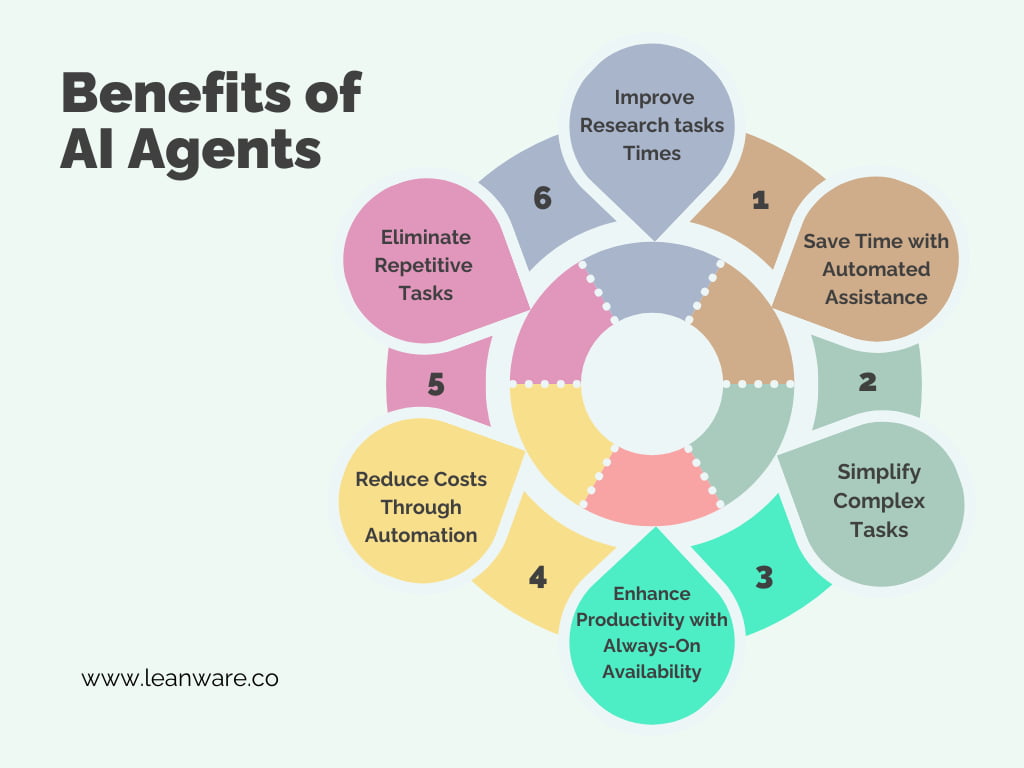
- Scalability: Agents can handle growing workloads without linear increases in headcount.
- Consistency: Well-trained systems deliver uniform quality across tasks.
- Agility: AI can adapt faster to new processes or markets than traditional workflows.
- Talent leverage: By removing repetitive work, employees can focus on innovation, strategy, and relationship-building.
However, success requires deliberate effort. Without governance, oversight, and talent development, AI adoption risks creating new inefficiencies or trust gaps. With the right approach, agents become not just tools but trusted contributors to business performance.
AI Agents = The Future of B2B
Integrating AI agents into the workplace will never be an abstract discussion again. For many businesses, it’s a competitive necessity. The five strategies outlined here – clear policies, collaborative partnership, human talent development, performance measurement, and the intern model – provide a practical framework for success.
Business leaders who approach integration with discipline and transparency will see AI agents strengthen their organizations rather than disrupt them. AI agents are ready to join your team. The question is whether your workplace is prepared to integrate them.
ISBM can help you stay ahead of the curve by connecting you with practical, research-driven insights into how B2B marketing is evolving. Through expert resources and peer collaboration, we provide the knowledge base and support needed to make informed decisions—especially in fast-changing areas like business market segments. We provide open courses and customized education programs for your marketing teams. Become a member today!