

The first quarter 2025 Gartner Chief Marketing Officer (CMO) Report is out, and while the headlines may sound fresh—market shaping, marketing yield, strategy alignment—they feel oddly familiar. That’s not a dig; in fact, it’s validation.
Much of what Gartner highlights aligns closely with what ISBM and Value Exchange Methodology (VEM) advocates have been saying for years: growth starts with deep customer understanding, clear strategic direction, and measurable business outcomes.
Gartner’s data-driven dive into CMO priorities is a helpful barometer for B2B marketers under pressure. The report doesn’t just identify issues; it quantifies them, and perhaps most importantly, it spotlights the growing expectation for marketing to demonstrate business value—not just brand impact.
Let’s unpack the most important parts of the report before zooming out to what all of this means for B2B marketers trying to keep their heads above water in a flood of change.
Quick Takeaways:
- Many CMOs struggle to articulate how their marketing strategy creates tangible value across the business.
- Organizations that see their CMOs as market shapers often exhibit higher strategic alignment and performance.
- Marketing leaders frequently overestimate how differentiated their strategies are in practice.
- Misalignment between marketing’s vision and the rest of the C-suite can limit the function’s perceived influence.
- Future-ready marketing requires integrating strategic storytelling with business outcomes that matter to stakeholders.
Roundup of Gartner’s Q1 CMO Report
1. Only 14% of CMOs Are “Market Shapers”
According to CEOs and CFOs, just 14% of CMOs are effectively influencing market dynamics. That low number should trigger more than concern—it should prompt action. Companies with effective market shaping strategies are 2.6x more likely to exceed revenue and profit goals.
The data speaks volumes, but so does the terminology. Gartner calls it “market shaping.” At ISBM, we’ve long called it Value Creation—identifying unmet needs, influencing demand, and shaping customer expectations. No matter the name, the gap is real. And so is the opportunity.
2. CMOs Are Struggling to Connect With Customers
A stunning 58% of U.S. consumers say brands don’t understand their needs. When you zoom in on B2B, the picture isn’t much prettier. This disconnect leads to underperforming campaigns, with 55% of marketing leaders reporting that their initiatives fail to generate enough sales to justify investment.
Translation: It’s not a messaging issue—it’s a customer insight issue. If marketing wants to fuel growth, it needs to rediscover the voice of the customer, not just during segmentation exercises, but continuously.
3. Marketing Impact Still Isn’t Tied to Business Outcomes
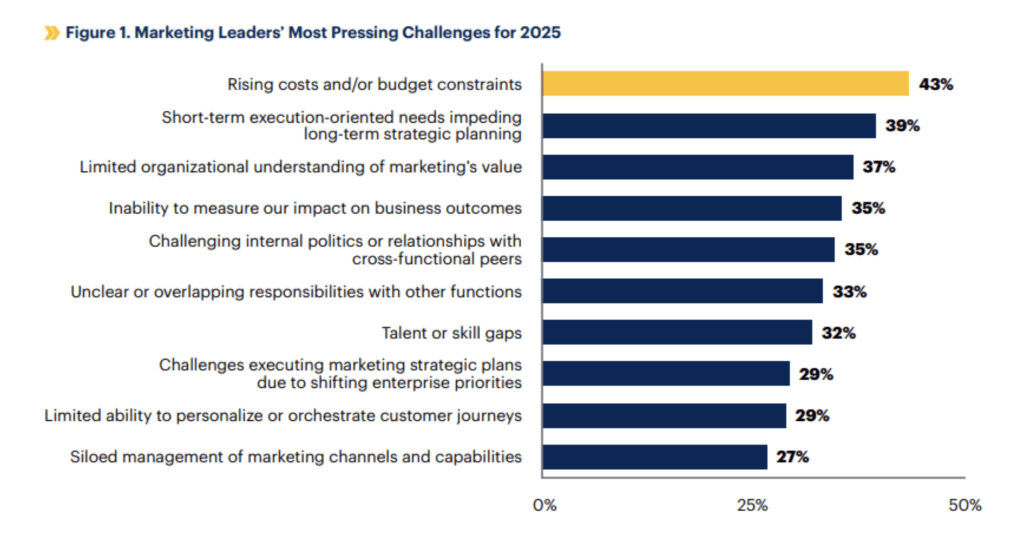
Here it is, again—plain and simple. Gartner states that if CMOs can’t tie their work directly to business outcomes, they lose credibility. We couldn’t agree more. At ISBM, we’ve made this challenge central to our mission.
Building a clear link between marketing and performance metrics takes effort, process, and cross-functional alignment. But without it, marketing becomes a cost center instead of a growth engine. The future belongs to those who measure what matters.
4. CMOs Are Drowning in Tactical Thinking
Disruption fatigue has driven many marketing departments into reactive mode. The Gartner report notes that the gap between strategy and operations is growing—marketing teams are falling into a cycle of short-term problem solving without long-term direction.
The solution? Recommit to the discipline of strategic planning and invest in roles that bridge the gap—like a marketing chief of staff or strategist. Strategy must not only be set but managed.
5. Customer Journey Investment Drives Yield
Gartner identifies prioritizing customer journey investments as one of three key strategic imperatives for 2025. Why? Because doing so maximizes marketing’s return. The takeaway: investing in journey mapping, personalization, and experience design isn’t just a UX play—it’s a revenue strategy.
In B2B, the stakes are even higher given the long sales cycles and multiple decision-makers. Marketing leaders must identify the friction points and double down on moments that influence conversion.
A Strategy Map, Not a Compass
Gartner’s strategic framework—transcending disruption, elevating enterprise impact, and maximizing yield—has strong bones. But bones don’t move unless there’s a muscle behind them. That muscle is alignment.
Strategic planning, in Gartner’s own language, must cascade from long-term business vision to operational execution. That means having:
- Clear objectives that link to enterprise outcomes
- Cross-functional ownership and alignment
- Resource allocation tied to strategic goals
- Measurable indicators of progress
This “strategy cascade” doesn’t just sound nice—it reflects a maturity model ISBM has been supporting through our research and executive forums. When marketing strategy floats above the day-to-day, it becomes aspirational wallpaper. When it’s embedded into operations with clarity and accountability, it becomes a performance lever.
Strategy Isn’t Strategy If You Can’t Measure It
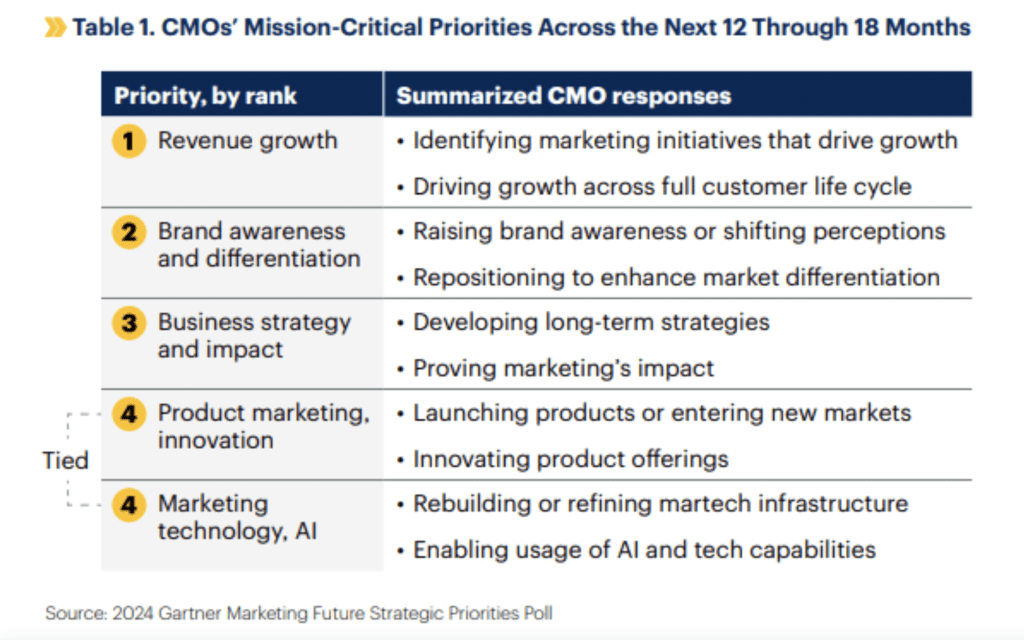
One of the most impactful sections of the report focuses on proving marketing’s value. Gartner calls on CMOs to build long-term value stories using a broader range of metrics. That might mean moving beyond last-touch attribution and embracing contribution metrics, strategic KPIs, and cross-functional alignment.
Here’s what this could look like in action:
- Short term: Track lead quality, conversion velocity, and account engagement.
- Mid term: Measure customer acquisition cost vs. lifetime value.
- Long term: Quantify brand equity, customer satisfaction, and innovation contribution.
Too often, marketers chase easy-to-measure proxies (clicks, likes, impressions) instead of aligning metrics with value creation. That’s why ISBM emphasizes frameworks like VEM, which start with business goals and build marketing strategies backward from those targets.
Wait, What About AI?
Yes, AI is in the report—and it’s treated with a refreshing level of nuance. Rather than touting generative AI as a magic wand, Gartner urges CMOs to look beyond surface-level use cases and develop an AI strategic roadmap. This means understanding where AI can meaningfully improve decision-making, personalization, content scalability, and operational efficiency.
Our advice? Don’t adopt AI just to say you did. Use it to enhance your ability to know your customer better and prove your impact faster. That’s where the long-term value lies.
“Marketing, Meet Metrics”
CMOs are facing louder expectations with fewer excuses. Gartner’s report should serve as both a reality check and a rallying cry. If your team is stuck in the tactical weeds, disconnected from business strategy, and unclear on how to define success—you’re not alone, but you do need to move.
The Gartner report might say “market shapers.” We say “value creators.” But in the end, we’re all pointing to the same truth: Marketing earns its seat at the table when it stops chasing trends and starts shaping outcomes.
ISBM is a nonprofit, global network of business researchers and practitioners. Ask about how an ISBM Membership can help you now or visit ISBM today to learn more!