
JT Mudge’s passion for strategic foresight goes far beyond only anticipating trends or analyzing data. His work focuses on creating equitable futures to make sure all individuals and communities have plenty of opportunities to thrive. As an adjunct professor at the University of Houston’s foresight program, Mudge combines academic expertise with practical insight to share his vision of inclusivity.
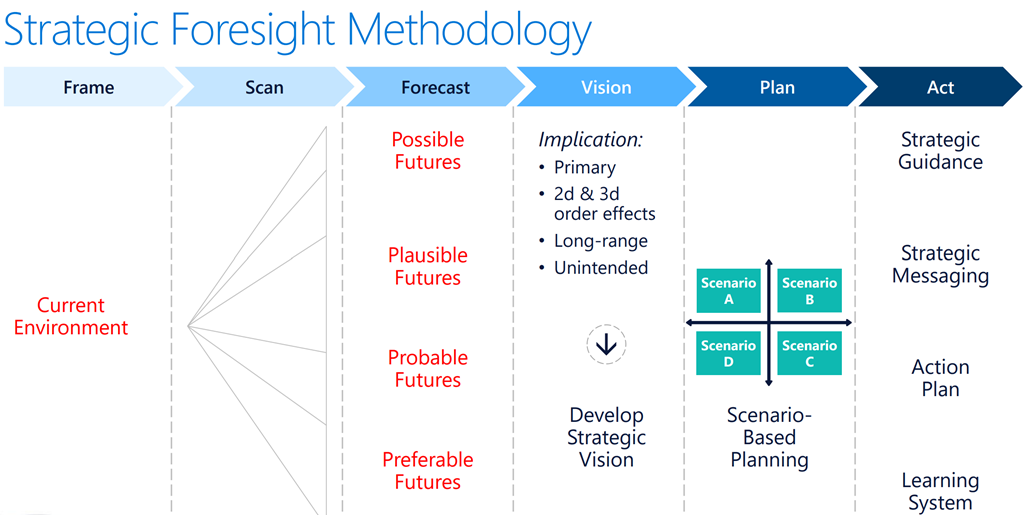
Future thinking helps anticipate the future, empowers businesses to actively build it, and assists in strategic planning and communication. In this article, we’ll review some tools provided by JT Mudge for taking future thinking and strategic foresight into action.
Four Quick Takeaways
Foresight resembles detective work: Much like Sherlock Holmes, futurists analyze small details that can spark significant trends.
Horizon scanning is essential: Identifying signals across different time frames and systems helps avoid blind spots in planning.
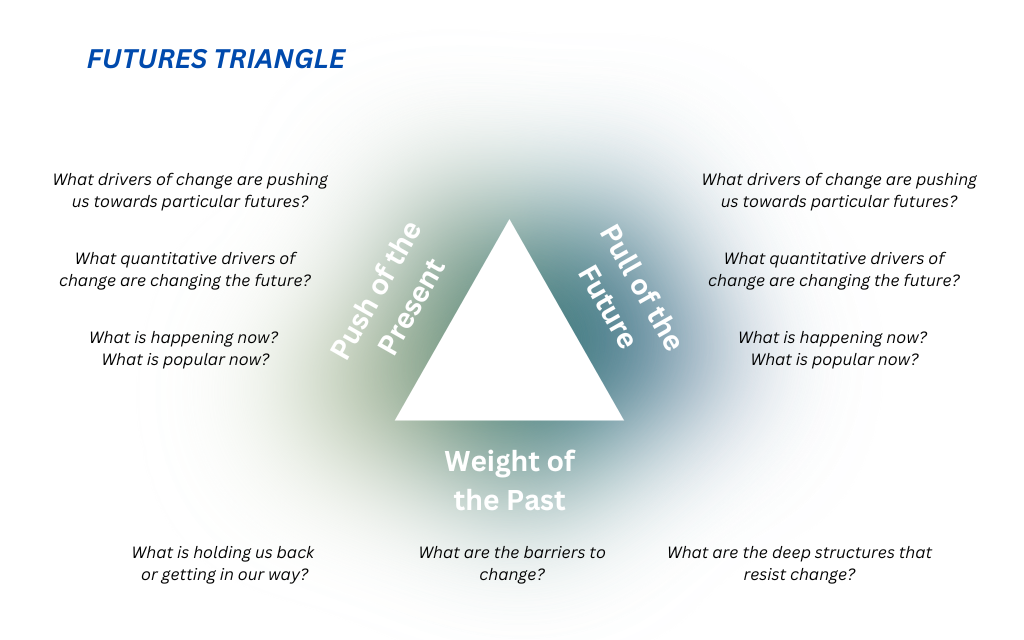
The Futures Triangle explains change: It maps the push of the present, pull of the future, and weight of the past to guide strategic decision-making.
Inclusivity strengthens foresight: Equity-focused futures planning benefits everyone by addressing barriers that hinder marginalized communities.
Strategic Foresight and the Role of Inclusivity
Strategic foresight involves structured methodologies to anticipate and prepare for potential futures. Unlike traditional planning, foresight encourages organizations to think critically about long-term outcomes and their broader impact. For Mudge, inclusivity is not just a moral imperative but a pragmatic one—societies flourish when everyone has access to opportunities.
Mudge’s focus on horizon scanning reveals how signals from various sectors, geographies, and timeframes provide critical insight. Scanning serves as an early-warning system, helping organizations adapt proactively. Yet, effective scanning also requires intentional inclusivity. A diverse range of perspectives can uncover signals that might otherwise be overlooked.
Seeing Beyond the Horizon
The concept of horizon scanning forms the foundation of Mudge’s approach. By examining first, second, and third horizons, organizations can better understand current systems, emerging possibilities, and transitional phases.
The first horizon represents the status quo, a prevailing system that inevitably loses relevance over time.
The second horizon is a transitional space where the old and new collide, marked by instability and competing values.
The third horizon embodies innovative ideas that may seem marginal today but hold the potential to redefine the future.
Understanding these horizons equips organizations to navigate uncertainty while fostering adaptive strategies.
The Futures Triangle: A Tool for Equity
Mudge frequently references the Futures Triangle, a framework developed by futurist Sohail Inayatullah, to illustrate the dynamics shaping the future:
- Pull of the Future: Aspirations and visions that draw society toward preferred outcomes.
- Push of the Present: Current drivers of change, such as technological advancements or demographic shifts.Weight of the Past: Legacy systems and traditional ways of thinking that resist transformation.
For Mudge, applying the Futures Triangle with an equity lens involves recognizing how the weight of the past can disproportionately burden marginalized communities. Breaking free from these constraints requires intentional planning that prioritizes the pull of inclusive futures.
Inclusivity in Action
Mudge’s emphasis on equity extends beyond theory. His approach includes actionable strategies that organizations can implement to create accessible futures:
Expand representation: Include voices from underrepresented groups in decision-making processes.
Design accessible systems: Develop innovations that address barriers faced by diverse populations.
Invest in education and training: Equip individuals with skills to thrive in future economies.
Promote collaboration: Build coalitions that bring together public, private, and community stakeholders.
These actions ensure that future developments uplift all communities, rather than perpetuating existing inequities.
Lifelong Learning in Futures Thinking
Mudge describes futures thinking as a transformative journey—one that fundamentally changes how individuals perceive the world. Teaching at the University of Houston’s foresight program, he encourages students to break old paradigms and embrace continuous learning.
Studying foresight, Mudge explains, taps into truths that may feel intuitive but remain unarticulated. By providing tools like horizon scanning and the Futures Triangle, he empowers participants to apply foresight in ways that promote equity and inclusion.
Foresight as a Detective's Journey
Mudge draws inspiration from an experience visiting London with his daughter, where a tour of 221B Baker Street sparked a realization about the detective-like nature of futurists. Observing the smallest details—what others might miss—often leads to significant insights.
This detective mindset is central to effective foresight. The ability to identify early signals can mean the difference between adapting successfully and being blindsided by change. Mudge believes this mindset can be cultivated through practice, with inclusivity serving as a guiding principle.
Building Futures That Work for All
Creating inclusive futures requires more than theoretical frameworks—it calls for action. JT Mudge’s advocacy for equity challenges organizations to rethink traditional approaches to planning and decision-making. By embracing tools like horizon scanning and the Futures Triangle, leaders can identify opportunities to promote accessibility and overcome systemic barriers.
Mudge’s vision serves as a reminder that foresight is not about predicting the future but shaping it. Inclusive planning ensures that future developments benefit everyone, fostering a world where all individuals and communities can thrive.
A Vision That Works for Everyone
The International Society for Business Marketing (ISBM) supports thought leaders like JT Mudge who bring innovative perspectives to strategic planning. Through our platform, we encourage collaboration and education, enabling businesses to find a path through uncertainty and drive meaningful change. Mudge’s emphasis on inclusivity aligns with ISBM’s mission to empower organizations to create a future that’s inclusive for everyone.
ISBM provides resources and tools designed to help B2B professionals be more inclusive and diverse. By becoming a member, you’ll gain access to expert guidance and strategies tailored to the unique needs of B2B organizations. Contact us for membership information and learn more about how we can support your business.