

Artificial intelligence is moving quickly, and businesses are racing to figure out how to put it to work in practical, scalable ways. Two concepts that come up in these discussions are prompt engineering and context engineering.
For business leaders, researchers, and strategists, understanding these methods is more than a technical detail – it’s about knowing how to build stronger systems that actually deliver value.
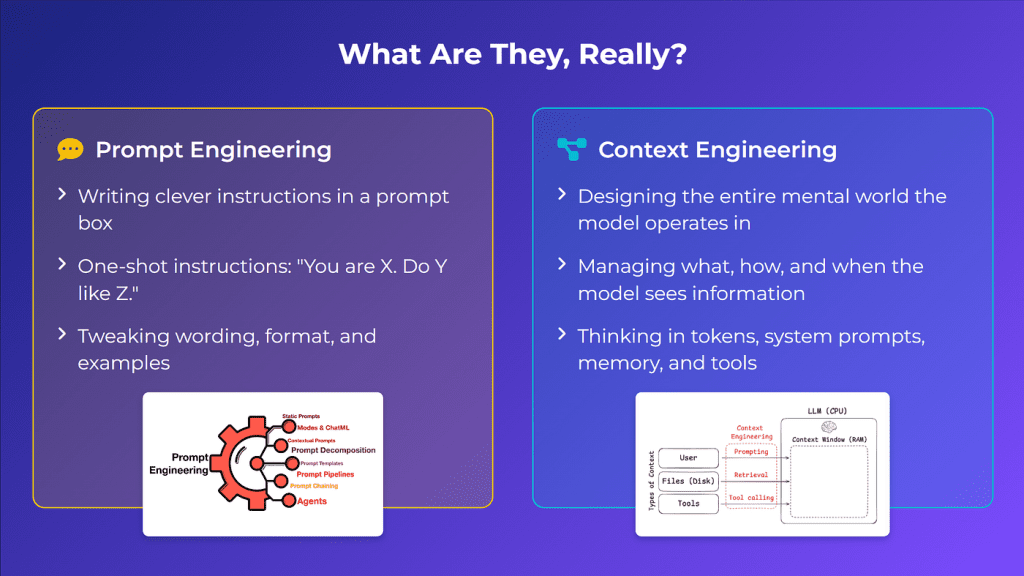
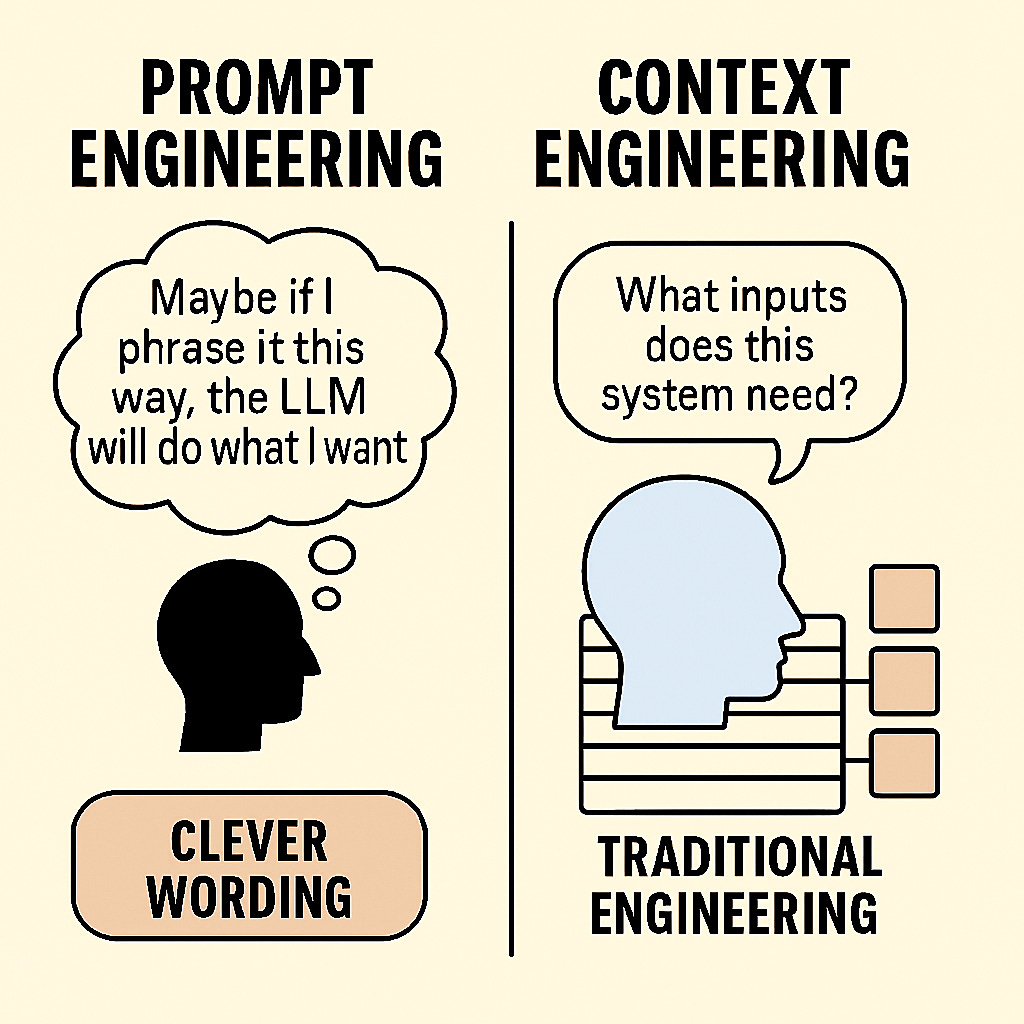
Prompt engineering has received the bulk of attention over the past few years. It’s centered on crafting better instructions for large language models (LLMs) so they produce more useful outputs. Context engineering, however, takes a step back and focuses on the entire environment in which those prompts are executed.
Both prompt engineering and context engineering can provide a powerful foundation for B2B applications. Yet their differences matter, especially for organizations aiming to integrate AI into operations, research, or decision-making in a reliable way.
Quick Takeaways
- Prompt engineering refines the way instructions are given to AI systems so outputs align with specific tasks.
- Context engineering builds the surrounding environment – tools, memory, and resources – that supports accurate and repeatable results.
- Both methods are complementary: prompts guide tasks while context ensures continuity and access to the right data.
- Challenges exist for each, from understanding model behavior in prompts to managing infrastructure in context engineering.
- Businesses that invest in both approaches will gain stronger, more adaptable systems that scale across B2B use cases.
What Prompt Engineering Brings to the Table
Prompt engineering is about how humans communicate with large language models. The quality of the instructions, or prompts, strongly influences the quality of the results. In B2B contexts, this could involve writing prompts that summarize research, analyze structured datasets, or draft materials aligned with a company’s tone and needs.
Some techniques include:
- Role Assignment – Defining the role of the system, such as acting as an analyst or researcher.
- Few-Shot Learning – Providing examples within the prompt so the model understands the output style.
- Chain-of-Thought Prompts – Encouraging the system to explain reasoning step by step, useful for complex tasks.
- Constraint Setting – Setting rules on tone, length, or format so the response meets requirements.
These methods make outputs more consistent and usable. For B2B organizations, prompt engineering can improve how AI systems support teams, whether by generating reports, extracting patterns from text, or conducting competitive analysis.
The problem, however, is that prompts alone can’t solve every problem. Even the best-crafted prompt may fall short if the system lacks memory of prior steps, access to external data, or the ability to track a multi-step process. This is where context engineering comes in.
Why Context Engineering Is Getting Attention
Context engineering takes a wider view. Instead of focusing solely on what is asked, it emphasizes what the system has at its disposal to carry out the request.
For businesses, this matters because real-world tasks are rarely solved in a single step. They often involve multiple actions, reference to prior knowledge, and integration with external systems. Without the right context, AI systems may provide incomplete, inconsistent, or outdated outputs.
The main components of context engineering include:
- Memory Management – Short-term memory captures ongoing conversations or steps, while long-term memory stores historical preferences and patterns for reuse.
- State Management – Tracks progress through multi-step tasks to maintain continuity.
- Retrieval-Augmented Generation (RAG) – Pulls in updated, relevant information from external databases or knowledge sources.
- Tool Integration – Enables the system to connect with APIs, data platforms, or third-party tools for expanded functionality.
For B2B organizations, this can look like an AI system that not only analyzes data but also cross-references it against a company’s internal database, tracks the progress of a workflow, and retrieves industry benchmarks in real time. Context engineering makes sure the system has the resources it needs to perform tasks reliably.
Prompt vs Context: How They Work Together
It isn’t a matter of choosing one or the other.
Prompt and context engineering work best when combined. Prompts shape the task, while context ensures the system can execute it effectively.
For example, a prompt might instruct an AI system to compare quarterly sales performance across regions. Context engineering ensures the system has access to the right dataset, understands the previous quarter’s analysis, and integrates with visualization tools to present the results. Without context, the output may be incomplete. Without a clear prompt, the system may misinterpret the goal.
The collaboration between these approaches is where real value emerges. Prompts sharpen the task, while context supports execution across multiple steps and environments.
Issues to Address
While the potential is promising, both prompt and context engineering come with their own sets of problems.
For prompt engineering:
- Deep understanding of how models interpret language is required.
- Small changes in phrasing can produce very different outputs.
- Prompts can be inconsistent if not documented or standardized across teams.
For context engineering:
- Strong infrastructure is required to manage memory, states, and external data.
- Integration across tools and systems can be complex.
- Maintaining updated knowledge sources requires ongoing effort.
B2B organizations need to prepare for these realities. Investments in technical expertise, system design, and data governance are required to see real results.
Business Benefits of Combining Both
When prompt and context engineering are implemented together, organizations see benefits like:
- Greater Accuracy – Systems can reference the right data and follow structured instructions.
- Improved Continuity – Multi-step workflows and historical preferences are maintained.
- Faster Workflows – Teams spend less time refining outputs or repeating steps.
- Scalable Processes – Systems can expand to new tasks without needing constant human adjustment.
- Stronger Decision Support – Leaders gain more reliable insights to guide planning and strategy.
For B2B leaders, this combination makes sure AI systems support – not hinder – business goals.
Practical Applications in B2B Environments
In B2B contexts, the mix of prompt and context engineering can be applied in several ways:
- Market Research – Prompts can ask for competitive summaries, while context ensures data is pulled from up-to-date sources.
- Sales Enablement – Prompts can guide tailored outreach messages, with context managing account histories and preferences.
- Operations – Prompts can request workflow updates, while context tracks ongoing tasks and system integrations.
- Knowledge Management – Prompts extract insights from documents, while context links them with stored archives and databases.
These are direct, practical applications that help organizations align AI capabilities with real business needs.
Context & Prompt: Looking into the Future
B2B organizations shouldn’t view prompt engineering as a quick fix or context engineering as out of reach. Both are accessible with the right planning and investment. The real opportunity lies in treating them as complementary methods that support each other.
As tools and infrastructure evolve, context engineering will become easier to implement at scale. Prompt engineering, meanwhile, will remain a key skill for shaping and refining tasks. Leaders who invest in both areas will be better prepared to deploy AI that actually drives results.
Start Building Stronger AI Systems Now
Prompt engineering and context engineering may sound like technical terms, but for B2B organizations they represent two practical ways of building stronger AI systems. Prompt engineering sharpens the task at hand, while context engineering makes sure the system has the memory, tools, and data to perform it effectively. When combined, they deliver accurate, consistent, and scalable results.
Organizations that recognize this balance will be positioned to use AI not as a one-off experiment but as a core enabler of decision-making, operations, and growth. In an environment where precision and adaptability both matter, understanding and applying these methods is no longer optional – it’s essential.
ISBM can help you stay ahead of the curve by connecting you with practical, research-driven insights into how B2B marketing is evolving. Through professional resources and peer collaboration, we provide the knowledge base and support needed to make the right decisions—especially in constantly-changing areas like performance marketing. We provide open courses and customized education programs for your marketing teams. Become a member now!