

Picture this: your company just invested in AI. Every department is experimenting – marketing is testing chatbots, operations is automating reports, and sales is using predictive models. But six months later, no one can say what’s working, who’s accountable, or how any of it connects to business results.
AI adoption has reached a tipping point. Yet most organizations are still running scattered pilots instead of a unified AI strategy. That’s why a new enterprise discipline is emerging – AI Capability Management (ACM). Much like ERP systems standardized back-office operations, ACM gives businesses structure and governance to manage AI as a true enterprise function.
Quick Takeaways
- AI is now an enterprise function, not an experiment. ACM treats AI as infrastructure, bringing it under the same discipline as ERP, CRM, and HCM systems.
- Governance matters as much as innovation. ACM introduces accountability and oversight to manage risk while maintaining agility.
- Fragmentation kills scalability. A unified AI workforce replaces one-off pilots and disconnected tools.
- AI success requires measurable impact. ACM helps leaders tie AI performance directly to business outcomes.
- Ainzel’s ACM model is leading the way. Early innovators like Ainzel show how ACM turns AI potential into real operational value.
What Is AI Capability Management?
AI Capability Management, or ACM, is a framework for governing and scaling AI across an enterprise. Think of it as an operating system for your AI workforce. It helps organizations move from experimentation to execution – managing hundreds of AI agents with structure, accountability, and measurable results.
Traditional enterprise systems each run a different domain. ERP manages finance and logistics. CRM manages customer relationships. HCM manages people and talent. ACM now manages your AI.
Instead of dozens of pilots running in silos, ACM centralizes them under one governed structure. It defines standards, assigns ownership, and integrates performance metrics into existing business processes. The result is clarity – who’s using what, why, and how it contributes to strategic goals.
Why Businesses Need ACM
Every company wants to scale AI. Few actually can.
Many organizations fall into the same trap: they build proofs of concept that never leave the lab. Teams work in isolation, models are trained on inconsistent data, and success metrics don’t align with leadership expectations. The result? Disconnected tools, duplicate spend, and unclear impact.
ACM solves that problem by introducing a system of record for AI. It’s how businesses:
- Govern how AI is used and monitored.
- Assign accountability for AI performance.
- Connect AI activity to business KPIs.
- Build transparency into model training, deployment, and use.
Without ACM, AI success depends on luck. With ACM, it becomes a repeatable process.
From Pilots to a Unified AI Workforce
AI adoption today looks a lot like business software in the 1990s – a patchwork of tools with no central management. ACM changes that by replacing fragmented pilots with a governed digital workforce.
Instead of teams experimenting in isolation, AI agents become managed employees. They’re onboarded, assigned roles, monitored, and measured. Each agent supports a business function and reports back on performance.
That’s the difference between experimenting with AI and operationalizing it. With ACM, those agents aren’t running independently. They’re part of a shared system that governs behavior, tracks results, and connects outputs to company-wide KPIs.
Governance: The Backbone of AI Maturity
Governance isn’t bureaucracy; it’s structure. AI needs it to scale responsibly.
ACM introduces governance that supports growth rather than slowing it down. That includes standards for data quality, bias detection, and ethical use. It also defines escalation paths when AI outputs go wrong – because in complex enterprises, they sometimes will.
Governance also gives leadership confidence. When a system documents how AI decisions are made, leaders can audit outcomes and build trust across departments. Without that, AI remains a black box – something that works, until it doesn’t.
ACM brings transparency to every layer: what models exist, who owns them, how they’re trained, and what results they drive. That clarity is what allows enterprises to scale AI safely.
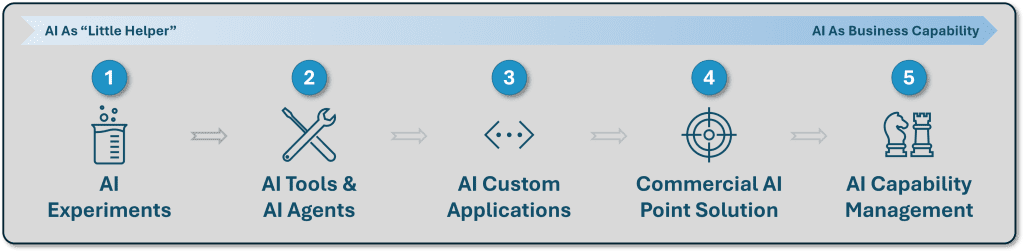
AI Experiments to Enterprise Discipline
AI’s early phase was about experimentation. Everyone wanted to try it. Now it’s about integration. Companies are realizing that true value comes from treating AI as an enterprise discipline – not a novelty project.
That means:
- Building centralized governance for all AI initiatives.
- Measuring AI output against real business metrics.
- Training employees to collaborate with AI agents, not compete with them.
- Using data feedback loops to improve performance continuously.
Much like ERP transformed back-office efficiency, ACM is now doing the same for AI. It’s not a trend – it’s a shift in how companies manage digital work.

What Makes ACM Different from Traditional AI Management
Most enterprises already manage AI projects through IT or data science teams. So what’s different about ACM?
ACM takes a broader view. It doesn’t focus only on algorithms or infrastructure. It manages AI as an organizational capability – one that spans departments, processes, and goals.
Here’s how ACM stands apart:
- Scale: ACM handles hundreds of AI agents across multiple functions.
- Accountability: It defines who owns each agent and how success is measured.
- Governance: It embeds policies for compliance, ethics, and oversight.
- Integration: It connects AI performance with enterprise systems like ERP and CRM.
- Visibility: It provides a single view of all AI activities, reducing shadow AI.
Think of ACM as the connective tissue between technical teams and business outcomes. It’s not about building new models — it’s about making the ones you already have work better together.
What Enterprises Gain from ACM
Adopting ACM delivers measurable impact fast. Companies report gains across three core areas:
1. Efficiency and Focus
Centralized governance eliminates redundant work. Teams stop building similar models in isolation and start reusing proven assets. That saves time and resources while improving quality.
2. Accountability and Trust
Clear ownership creates accountability. When teams know who manages each AI function, results improve — and leadership gains confidence in reported outcomes.
3. Scalable Innovation
ACM turns AI into a repeatable process. Once standards and systems are in place, new AI agents can be launched faster, safely, and with measurable results.
It’s not just about saving time. It’s about building an AI workforce that grows as your business does.
How AI Capability Management Fits in the Enterprise Stack
ERP runs your back office. CRM runs relationships. HCM runs your people. ACM now runs your AI.
As enterprises digitize workflows, AI becomes another type of workforce — one that needs structure, roles, and accountability. ACM provides that framework, integrating AI into existing systems rather than replacing them.
For example:
- AI outputs feed into ERP for automated financial adjustments.
- Customer sentiment analysis syncs with CRM for improved engagement.
- Talent insights link with HCM to support workforce planning.
In short, ACM doesn’t disrupt existing enterprise software — it connects it.
That’s why companies using Microsoft, Salesforce, or SAP can still benefit from ACM. It complements what they already have, creating an orchestration layer that manages AI across platforms.
ACM in Action: Measurable Business Impact
AI Capability Management is already reshaping how companies think about digital operations.
Sales teams gain sharper account insights by connecting predictive models with CRM data.
Finance leaders improve forecast accuracy using AI simulations validated through governance workflows.
Strategy leaders run dynamic scenario planning powered by data-driven decision agents.
These aren’t pilots – they’re operational systems. And they’re happening today in enterprises embracing ACM.
Ainzel, for example, is among the first to formalize ACM as a discipline. Their platform manages AI agents under unified governance, helping companies measure impact and scale with confidence. But the broader story is bigger than any one vendor. ACM represents a shift in how all enterprises manage the next generation of digital work.
Where Is AI Capability Management Headed Next?
ACM is still new, but adoption is accelerating. As enterprises mature in their use of AI, they’re realizing experimentation alone doesn’t scale. Governance, visibility, and measurable performance are becoming baseline expectations.
Expect ACM to evolve in three directions:
- AI Workforce Integration: Businesses will blend human and AI collaboration through shared workflows.
- Cross-System Orchestration: ACM will connect data and insights across ERP, CRM, and analytics platforms.
- Governed Innovation: AI experimentation will continue — but under guardrails that protect data and ethics.
It’s the next evolution of enterprise intelligence — one that turns AI chaos into structured capability.
What Does This Mean for You?
If you’re leading an enterprise team, ACM isn’t a concept to file away. It’s a model to start planning for now.
Ask yourself:
- Who manages your AI initiatives today?
- How do you measure AI impact across departments?
- Where’s the single source of truth for your AI performance?
If those answers aren’t clear, ACM can help.
Could AI Capability Management Be the Next ERP Moment?
Enterprise technology has evolved in waves – ERP standardized operations, CRM structured relationships, and HCM organized talent. Now AI Capability Management is emerging as the next discipline defining enterprise value.
Ainzel may have sparked the term, but ACM is bigger than a single vendor. It’s the framework that helps every organization put AI agents to work with governance, structure, and measurable results.
ISBM can help you stay ahead of the curve by connecting you with practical, research-driven insights into how B2B marketing is evolving. Through professional resources and peer collaboration, we provide the knowledge base and support needed to make the right decisions—especially in constantly-changing areas like performance marketing. We provide open courses and customized education programs for your marketing teams. Become a member now!