

You’re not marketing to “small businesses.”
You’re marketing to decision-makers who run dental offices, auto repair shops, freight brokerages, or niche manufacturers. Those aren’t the same buyer. They don’t care about the same problems, and they definitely won’t respond to the same message.
Small business market segments help you focus your time, your budget, and your sales pitch on buyers who are actually going to buy through better buyer targeting. That means less guessing and more traction. If you’re tired of shouting into the void—or worse, getting leads that go nowhere—segmenting your audience through effective market segmentation might be the highest-impact thing you can do next.
Forget mass appeal. You’re not a soda brand. You need to be relevant.
Quick Takeaways:
- Small businesses aren’t one-size-fits-all. Segmenting by behavior, triggers, and decision-maker roles is more effective than just relying on industry.
- Focused segmentation drives faster, sustainable growth with proven segmentation strategies for growth. Targeting a specific, high-performing segment helps sharpen messaging, reduce churn, and close deals faster.
- Segmentation improves product strategy. Knowing how different segments use your product leads to smarter feature development and onboarding.
- Marketing becomes more efficient. Tailored campaigns attract the right buyers, waste less budget, and boost conversions with clearer messaging.
- Start with your best current customers. Identify patterns among your top retained accounts and build segments around what’s already working.
Small Business Market Segments: Not All Small Businesses Are Equal
Lumping all small businesses into one bucket is like saying every dog is the same because they all have tails. You wouldn’t pitch a pet-sitting service the same way to a local vet as you would to a boutique dog bakery. Same goes for small manufacturers vs. SaaS startups.
Start thinking of segments as categories of pain points. You’re not selling a product. You’re solving a problem. The more specifically you define that problem—and who experiences it—the easier it gets to make your message hit.
Let’s say you offer payroll software. You could sell to any small business, sure. But if you narrow it down to restaurants with tipped employees or construction crews with rotating subs, you suddenly have a message that cuts through the noise. You don’t sound like everyone else anymore.
That’s the difference between spraying and praying and showing up with strong positioning that people actually want.
Segments Aren’t Just About Industry
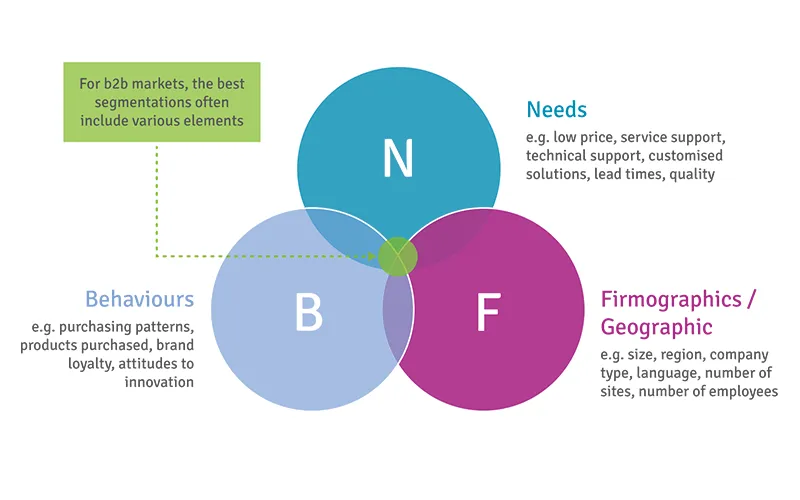
A lot of B2B companies default to industry verticals. And while that’s fine as a starting point, it often misses the mark. You’re better off grouping buyers by shared behaviors, needs, or triggers.
For example, two completely different industries might both deal with long onboarding times for new vendors. That’s a shared pain, and if your solution removes that friction, you can speak to both groups without losing relevance.
Segments can also be built around operational models, growth stages, decision-maker roles, or even buying triggers like recent funding or expansion. The point is to find clusters of similarity that go beyond job titles or NAICS codes.
And once you find them? Everything gets easier.
Better Segmentation = Better Messaging
Generic sales copy is easy to ignore. Buyers are busy, skeptical, and trained to sniff out fluff. A generic message wastes their time. A targeted message earns their attention.
If you know your buyer segment struggles with high turnover, talk about how your system reduces onboarding time by 40%. If they’re buried in compliance paperwork, lead with your audit-proof reporting tools. When you speak to what they’re already thinking about, you don’t have to convince them they have a problem. You just show up with a fix.
Effective segmentation makes messaging feel personal—even if you’re still marketing at scale.
It also keeps your team focused. When sales and marketing align around shared segments, they stop stepping on each other. Sales stops chasing unqualified leads. Marketing stops guessing what to say.
You get traction instead of noise.
Segmenting Helps You Prioritize (Because You Can’t Do It All)
Most small B2B companies don’t have the luxury of huge ad budgets or 20-person sales teams. That means you need to pick your battles. Segmentation helps you identify which buyers are most likely to close, stay, and grow. Not just those who like your demo—but those who actually benefit long-term.
You don’t want to spend months selling to a segment that churns after 60 days. That’s just expensive customer service.
Instead, look at things like:
- Lifetime value by buyer type
- Sales cycle length
- Feature usage by segment
- Renewal or retention rates
When you use real data to guide your segmentation strategy, you stop spinning your wheels. You know where your best buyers live, and you go there on purpose.
Common Segment Types That Work for B2B
Let’s break down a few segmentation models that go deeper than just industry or headcount.
1. Operational Segments
Group buyers based on how they run their business. For example, businesses with remote teams may care more about cloud-based access. Businesses with complex logistics may need advanced tracking.
2. Buying Behavior Segments
Some buyers research for months. Others jump in after a 20-minute call. Knowing how your segments make decisions helps you customize your sales process—and shorten the timeline.
Maybe retail franchise owners want a full demo and onboarding guide, while independent contractors want to know they can get started today. Adjust accordingly.
3. Trigger-Based Segments
Some small businesses only start looking for a solution after something changes. That might be hiring their first HR person, opening a second location, or switching accounting firms. If you understand these triggers, you can time your outreach to hit when they’re most ready to act.
4. Role-Specific Segments
Don’t forget who’s actually making the call. A CFO will have different questions than an office manager. Some businesses are founder-led; others delegate decision-making. Segment by role, and tailor your message to how that person evaluates value.
Not Just a Marketing Tactic
When you define small business market segments with intent, it doesn’t just improve your marketing efforts, it morphs your entire operation. By targeting the right market segments, your marketing becomes more efficient, and you stop wasting your budget on reaching the wrong audience.
The sales process becomes faster too, as you’re not spending time re-educating prospects who aren’t aligned with what you offer. Your product roadmap gets more focused and purposeful since you’re building features that cater to the needs of your best segments. As a result, your churn rate drops because you’re onboarding buyers who actually need your products or services.
What Happens Without Segmentation?
When you try to build a product for everyone, you end up selling it to no one. Your sales team chases leads that aren’t a good fit, and your marketing team gets blamed for poor MQLs. Meanwhile, your product team ends up building features that nobody uses, wasting time and resources. It’s a slow death by generalization.
Segmenting your market is the work that makes everything else easier. By honing in on specific market segments, you streamline your sales, marketing, and product efforts, making each more effective and efficient.
How to Start Small
You don’t need a PhD in data science to segment your market. Start small by looking at your current buyers and identifying the ones who, using a practical customer segmentation guide: bought quickly, needed minimal hand-holding, renewed or upgraded, or referred others.
What do they have in common?
It could be industry, company size, role, or use case. Once you spot those patterns, you’ve found your starting segment. From there, test your messaging. Build one landing page and launch one targeted campaign. Talk to one niche at a time. You’ll learn faster, win faster, and grow faster.
You Don’t Need to Be Everywhere. You Just Need to Be in the Right Place.
Trying to appeal to every small business means competing against everyone else, often with more resources. But segmentation changes the game. You stop chasing and start attracting. You stop guessing and start repeating what works. Instead of trying to win the market, you start winning your market.
ISBM can help you stay ahead of the curve by connecting you with practical, research-driven insights and B2B growth resources into how B2B marketing is evolving. Through expert resources and peer collaboration, we provide the knowledge base and support needed to make informed decisions—especially in fast-changing areas like business market segments. Become a member today!