

It’s time to talk about our current business market.
It’s changing at lightning speed, meaning it’s also unpredictable. Today’s organizations have to sort through seemingly endless variables and complications that impact, well, everything, making strong customer intelligence strategies increasingly important, making strategic marketing analysis essential. Fluctuating market conditions, new regulations, disruptive innovations – the challenge is not just understanding what might happen but also developing strategies to respond.
Two frameworks that help address these changes are Delphi Forecasting and VUCA (Volatility, Uncertainty, Complexity, and Ambiguity), two essential marketing analytics frameworks.
Delphi Forecasting is a structured method that systematically gathers insights to make the business world less uncertain. On the other hand, VUCA is a framework that recognizes precise predictions are most likely impossible, categorizes the type of unpredictable market force, and responds accordingly.
While Delphi aims to create expert-driven forecasts, VUCA suggests that businesses should prioritize being adaptable rather than total certainty as part of a market uncertainty strategy. Let’s take a closer look at how these concepts intersect and how they help modern business.
Quick Takeaways
Delphi Forecasting helps reduce uncertainty by gathering expert insights through multiple structured rounds of questioning.
VUCA highlights the four characteristics of unpredictable environments—volatility, uncertainty, complexity, and ambiguity—and suggests building resilience and risk management instead of seeking precise predictions.
Organizations face a paradox—while Delphi tries to improve forecasting accuracy, VUCA suggests that unpredictability is an inherent challenge.
Combining Delphi and VUCA thinking can help businesses make informed decisions as structured B2B decision making models while preparing for unexpected shifts.
Delphi Forecasting: A Structured Approach to Uncertainty
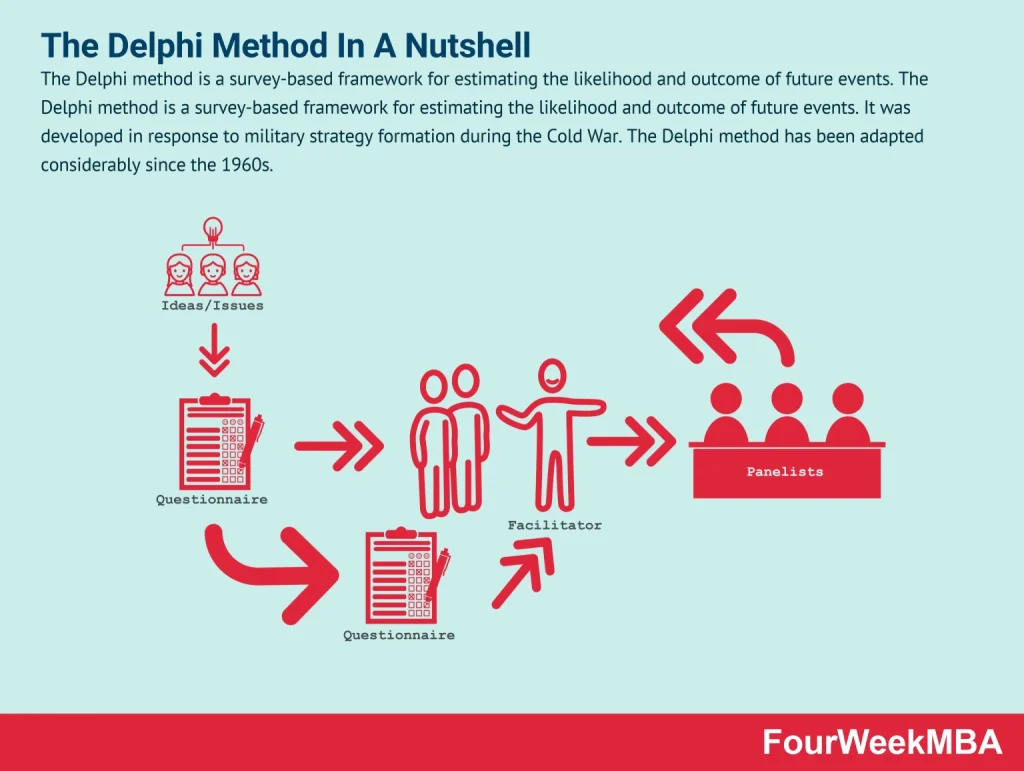
Developed by RAND Corporation in the 1950s, Delphi Forecasting is a structured communication technique and one of several business forecasting methods designed to harness expert opinion for predicting future developments. It operates through multiple rounds of anonymous questionnaires, with controlled feedback loops that refine collective insights over time.
Characteristics of Delphi Forecasting:
Anonymous Participation – Experts provide their input without knowing others’ identities, which reduces dominant voices and prevents groupthink.
Iterative Process – The same group of experts answers multiple rounds of questions, refining their responses based on previous results.
Statistical Aggregation – Group responses are compiled and analyzed, often leading to models such as Monte Carlo simulations.
Controlled Feedback – Participants review aggregated responses and adjust their answers if necessary, allowing for a gradual movement toward consensus.
Expert Consensus – The ultimate goal is to synthesize a reliable expert-driven forecast on complex topics.
Why Does it Matter?
Delphi Forecasting is particularly useful when historical data is insufficient, and expert judgment is needed to predict emerging trends. This method has been applied in industries ranging from healthcare and technology to policy-making and financial markets. By minimizing bias and structuring expert input, it provides businesses with a more systematic way to address uncertainty.
However, despite its effectiveness, Delphi Forecasting is not infallible. It assumes that expert consensus leads to accurate predictions, but unforeseen variables
Understanding VUCA: A Framework for Unpredictability
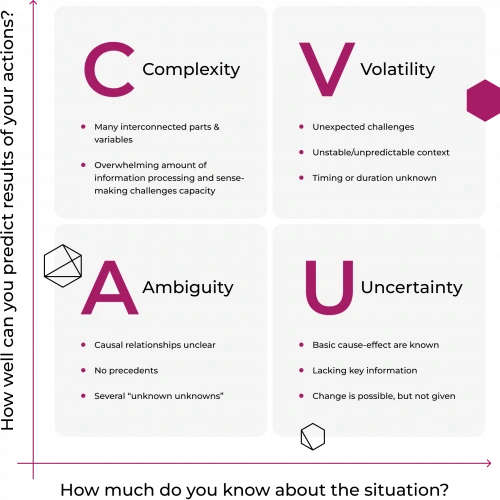
VUCA is an acronym used to describe environments characterized by four specific challenges:
Volatility – Rapid and unpredictable changes in conditions (e.g., raw material price fluctuations).
Uncertainty – A lack of predictability in how events will unfold (e.g., changing regulations).
Complexity – The presence of multiple interconnected factors that influence outcomes (e.g., global supply chains).
Ambiguity – Situations where the meaning of events is unclear (e.g., emerging technologies with uncertain market impacts).
How VUCA Works
In today’s business landscape, organizations frequently encounter VUCA conditions. For example, consider:
Volatility: Oil prices fluctuating unpredictably, affecting transportation and manufacturing costs.
Uncertainty: Sudden regulatory changes impacting market access.
Complexity: Companies like Bosch managing intricate supply chain networks with thousands of interconnected parts.
Ambiguity: AI-driven business models evolving in ways that even industry leaders struggle to anticipate.
Unlike Delphi Forecasting, which seeks to reduce uncertainty through structured expert consensus, VUCA suggests that uncertainty is inevitable and must be managed based on impact, predictability and the VUCA category,.
How Delphi and VUCA Work Together
The relationship between Delphi Forecasting and VUCA is both complementary and contradictory. Delphi is an attempt to impose order on uncertainty, using expert insights to create structured predictions. VUCA, however, suggests that some aspects of predictability are irreducible and must be accepted as part of the business environment.
So, how can organizations balance these two perspectives? The key is combining structured forecasting with adaptable strategies:
Use Delphi Forecasting to gather expert insights and create well-informed scenario models.
Apply VUCA thinking to recognize the limits of forecasting and build flexible strategies, risk management and leadership approaches based on the impact of the market force and its VUCA category.
Develop dynamic decision-making frameworks that integrate predictive insights with contingency plans to support scenario planning B2B.
Practical Business Applications
Now, how do you apply Delphi and VUCA to your business?
1. Managing Market Volatility
A company facing volatile raw material prices might use Delphi Forecasting to consult industry experts about potential price trends. Simultaneously, they should apply VUCA thinking by developing flexible pricing models and alternative supply sources.
2. Responding to Regulatory Uncertainty
A company facing volatile raw material prices might use Delphi Forecasting to consult industry experts about potential price trends. Simultaneously, they should apply VUCA thinking by developing flexible pricing models and alternative supply sources.
3. Navigating Complications in Global Supply Chains
Companies like automotive manufacturers operate within highly complex supply chains. While Delphi Forecasting can help predict potential disruptions, VUCA thinking encourages resilience—such as diversifying suppliers or investing in real-time monitoring technologies.
4. Adapting to Ambiguous Technological Shifts
Emerging technologies like AI and blockchain present ambiguous business opportunities. Delphi Forecasting can help assess expert views on likely developments, but organizations should also adopt a VUCA mindset—experimenting with small-scale implementations before committing to large-scale changes.
A Dual Approach Using Marketing Analytics Frameworks
Neither Delphi Forecasting nor VUCA alone provides a perfect solution to uncertainty. However, when used together, they are a powerful approach for organizations navigating unpredictable markets and applying proven innovation best practices.
Delphi provides structured forecasting based on expert consensus, while VUCA reminds us to embrace adaptability and resilience in the face of uncertainty.
ISBM is a nonprofit, global network of business researchers and practitioners. Ask about how an ISBM Membership can help you now or visit ISBM today to explore our learning programs and learn more!